
Torsion Springs at Cycle Limit
Torsion springs installed with the 2000s-era builds have hit their rated cycle limit and are failing on schedule for doors of that age.
Local garage door service · Little Elm, TX
Little Elm garage door repair and installation for 2000s-era homes, covering spring repair, cable repair, opener install, and off-track repair.

Garage door services
From emergency repair and cable repair to opener installation, off-track repair, maintenance, new door installation, and general garage door service, the lineup is built around Little Elm's 1988-2014 housing stock and its builder-grade 2000s-era hardware.


Common Little Elm garage door problems
Because the housing stock here skews 2000s, the failures we see most are the ones that show up right on schedule for doors of that age: torsion springs that have hit their cycle limit, nylon rollers that have gone brittle, and openers from the original builder-grade install finally giving out on the circuit board. We don't see much of the older side-mounted hardware you'd find in a pre-1980s neighborhood - this area mostly skipped that era entirely. What we do see is garage doors that were installed fast during a building boom, with hardware sized for cost, not longevity. That means a lot of our repair calls are the same spring size and the same bracket pattern, which keeps parts on the truck and keeps most jobs same-day.
Torsion springs installed with the 2000s-era builds have hit their rated cycle limit and are failing on schedule for doors of that age.
Nylon rollers from the original install have gone brittle over the years and are a steady part of the repair calls we run here.
Openers from the original builder-grade install finally give out on the circuit board, the weak point on those units.
A lot of calls are the same spring size and the same bracket pattern, which keeps parts on the truck and keeps most jobs same-day.
We don't see much of the older side-mounted hardware from a pre-1980s neighborhood - this area mostly skipped that era entirely.
Clear repair guidance
We don't publish a flat price list because no two doors are the same, even on the same street. A 16-foot double door with a heavy insulated panel costs more to spring than a single lightweight door, and we're not going to pretend otherwise.
What we can tell you is that we price the job, not the visit: the diagnostic is part of the repair, not a separate charge stacked on top. That keeps the number honest, because you're paying for what the door actually needs rather than for a truck showing up.
The hardware across this area's 2000s-era builds is uniform enough that we usually know the common spring sizes and bracket patterns before we arrive, which keeps parts on the truck and most jobs same-day. That predictability is part of why the pricing stays straightforward.
If a repair isn't worth it - say, an opener that's failing alongside a door that's already out of square - we'll tell you that plainly instead of running up a bill on a door that should be replaced.
Local housing matters
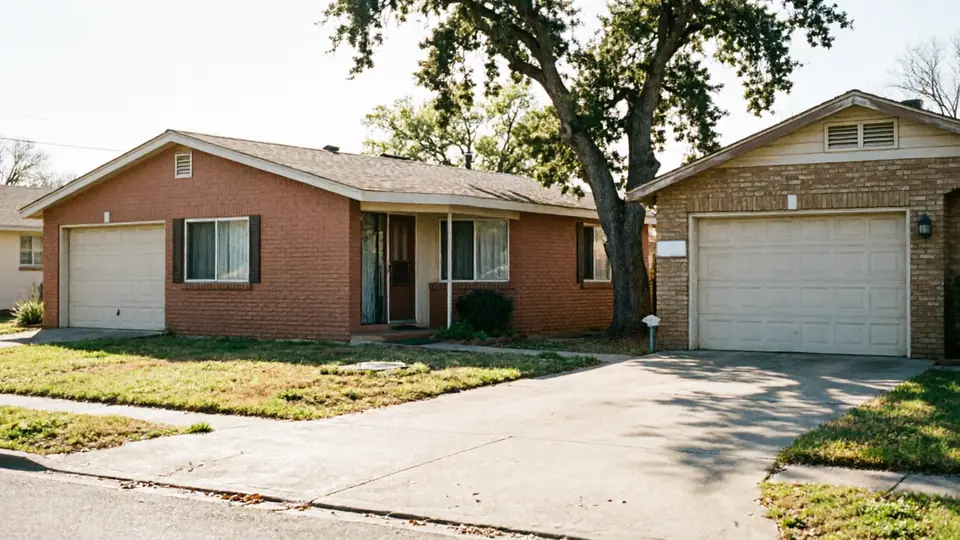
Most of the garage doors we touch sit on houses built between 1988 and 2014, with the median build year landing around 2003. That's not a random stat - it's the actual age of the stock across the 23 named areas we work in, and it shapes almost every call we take.
A door installed in 2003 is old enough to need its torsion spring replaced at least once, but new enough that most owners assume it's still new. That gap between how old the hardware actually is and how new it feels drives a lot of the surprise when a spring or opener finally goes.

What we do see is garage doors that were installed fast during a building boom, with hardware sized for cost, not longevity. If your house went up in that same late-80s-through-2013 wave, odds are good we've worked on a near-identical door two streets over.
Because the stock is so uniform, the opener, spring, rollers, and brackets on one house usually match the next - which is exactly why the common parts stay on the truck and most repairs land same-day.
Heat and garage door wear
This area sits in a moderate-heat climate band, which matters more for garage doors than most people think. Heat doesn't just warp panels over time - it's hard on the lubricant in rollers and hinges, and it's hard on opener circuit boards mounted in a garage that routinely runs hotter than the house.
Heat works on garage door panels over time, so the warping that shows up here is a slow, climate-driven wear pattern rather than a one-off failure.
The moderate-heat climate is hard on the lubricant in rollers and hinges, which dries out and lets those moving parts run rougher than they should.
An opener mounted in a garage that routinely runs hotter than the house takes real heat stress on its circuit board, the part that tends to give out first.
Owners here lean toward insulated panels and openers with better thermal tolerance than the builder-grade unit that came with the house, built to handle heat without constant upkeep.
What to expect
You tell us what the door is doing, and because the hardware across this area's 2000s-era builds is so uniform, we can often figure out the part before a truck ever rolls - then give you a straight repair-or-replace answer without the upsell.
Won't open, stuck halfway, making a noise, opener running but the door not moving - you tell us what it's doing and we figure out roughly what it needs before a truck ever rolls.
Given how uniform the hardware is across this area's 2000s-era builds, we're often able to guess the part with real confidence before we see the door in person, which cuts down on return trips.
We'll give you a straight answer on whether it's a repair or a replacement, instead of defaulting to whichever one costs more.
We won't talk you into a new door when a $40 part will get you another decade out of the one you've got.
Response Time Varies by Location
We don't quote a blanket response time because it depends on where you are in the service area and what's already on the truck - but most repairs on this area's common hardware are same-day, since the parts match what we carry.
Repair or replace?
A broken spring, cable, roller, or opener doesn't automatically mean the whole door needs replacing. On this area's 2000s-era doors, repair usually makes sense when the panels are solid; replacement becomes the better value only when several things are failing together.
If the panels are solid and it's just a spring, cable, or roller issue, repair almost always makes sense on these doors.
If the opener is failing at the same time the door is out of square or the track is bent, replacement is often the better value than stacking repairs.
We won't talk you into a new door when a $40 part will get you another decade out of the one you've got.
When a door is genuinely done, we'll tell you honestly instead of running up a bill on repairs that won't hold.
2000s-era garage door systems
Little Elm's stock went up fast in one late-80s-through-2013 wave, so the garages here share a recognizable mix: builder-grade torsion springs, chain-drive openers, and nylon rollers all installed around the same time and reaching the end of their life in the same window now.
Torsion springs from the original build are old enough to need replacing at least once, even on homes owners still think of as new.
The original chain-drive opener units are now reaching the end of their service life, usually giving out on the circuit board first.
Nylon rollers from the original install go brittle over the years and are one of the parts that fail on schedule for doors of this age.
These doors were installed fast during a building boom, with hardware sized for cost, not longevity, so the weak points are predictable.
This area mostly skipped the older side-mounted hardware era, so we rarely deal with the pre-1980s setups common in older neighborhoods.
Built around Little Elm garage doors
With the hardware so uniform across this area's 2000s-era builds, the common spring sizes, bracket patterns, openers, and rollers repeat house to house - so we diagnose against what's actually on your door and keep the matching parts on the truck.
A lot of jobs are the same spring size and the same bracket pattern, so the parts that fit most of the area's doors ride on the truck.
Because the hardware is uniform, we can often guess the part with real confidence before we see the door, which cuts down on return trips.
If the panels are solid and one component is the actual failure, there's no reason to replace a whole door that still has life in it.
When the opener is failing alongside a door that's out of square, we say plainly that replacement is the better value instead of stacking repairs.
Service areas
We're based in Little Elm and most of our calls stay close: Paloma Creek is about two miles NNW, Oak Point around four, and Cross Roads about five. Farther out we still run jobs in Shady Shores and Lake Dallas, both around seven miles, and out to Hickory Creek, Aubrey, and Corinth near the nine-mile mark. Highland Village rounds out the nearby towns we cover on a regular basis.
The hardware and build era are similar enough across all of these areas that most jobs look familiar before we even arrive - if your house went up in that same late-80s-through-2013 wave, odds are good we've worked on a near-identical door nearby. The closer you are to Little Elm, the easier it is to land same-day scheduling; the farther out we drive, the more it helps to have some flexibility on timing so we can batch the route with a nearby call.
From our Little Elm, TX base we run trucks across the surrounding towns rather than keeping a storefront in each one. Supported suburb pages cover Highland Village, Oak Point, Paloma Creek, and Shady Shores - pick yours to see the local detail.
Questions
Yes. We run regular calls out to Oak Point (about 4 miles out), Cross Roads (5 miles), and the other nearby areas we service - Paloma Creek, Shady Shores, Lake Dallas, Hickory Creek, Aubrey, and Corinth among them. The hardware and build era are similar enough across these areas that most jobs look familiar before we even arrive.
A lot of homes here got a builder-grade opener during the original build, and those units aren't built for a Texas garage that runs hot most of the year. Heat is hard on the circuit board and the gear assembly. It's one of the most common failures we see on houses from this area's main building wave.
Depends on the door. If the panels are solid and it's just a spring, cable, or roller issue, repair almost always makes sense. If the opener's failing at the same time the door's out of square or the track is bent, we'll tell you honestly when replacement is the better value instead of stacking repairs on a door that's done.
We don't quote a blanket response time because it depends on where you are in the service area and what's already on the truck. What we can say is that most repairs on this area's common hardware are same-day, since the parts match what we carry for the bulk of the 2000s-era doors we work on.
Ready when you are
Tell us what the door is doing and we'll help you work out what it needs across Little Elm.